Eventjes doorlezen:
observations
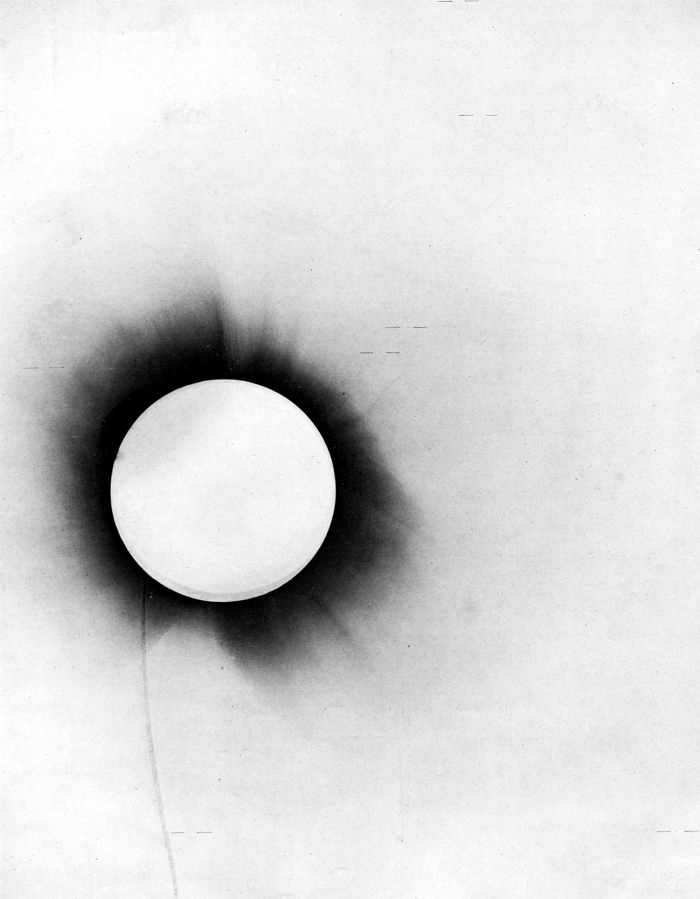
The original photograph of the 1919 eclipse which was claimed to confirm Einstein's theory of general relativity.In 1919, the observation of a total solar eclipse helped to confirm Einstein's theory of general relativity. By comparing the apparent distance between two stars, with and without the Sun between them, Arthur Eddington stated that the theoretical predictions about gravitational lenses were confirmed, though it now appears the data were ambiguous at the time. The observation with the Sun between the stars was only possible during totality, since the stars are visible then. [31]
die 31 verwijst naar een link onderaan de wiki-pagina:
31: ^ ESA. Relativity and the 1919 eclipse.
en die link zegt:
Relativity and the 1919 eclipse
Probably the most important eclipse in the history of science occurred on 29 May 1919. Just six months after the end of World War I, British astronomers used it to test a new idea that came from Germany in 1915.
The proposition was that gravity affected light, space and time itself, and as a result the Sun would deflect starlight passing by it. Changes in the apparent direction of stars in the sky, seen close to the Sun during a total eclipse, could confirm the idea.
The announcement of favourable results in London on 8 November 1919 signalled the replacement of Newton's theory of gravity by the theory of general relativity. Its originator, a 40-year old Berliner called Albert Einstein, at once became the most famous scientist in the world.

 Puzzels
 .
.